THE MAGNIFICENT GARDENS AT THE HOTEL CHINZANSO IN TOKYO, JAPAN
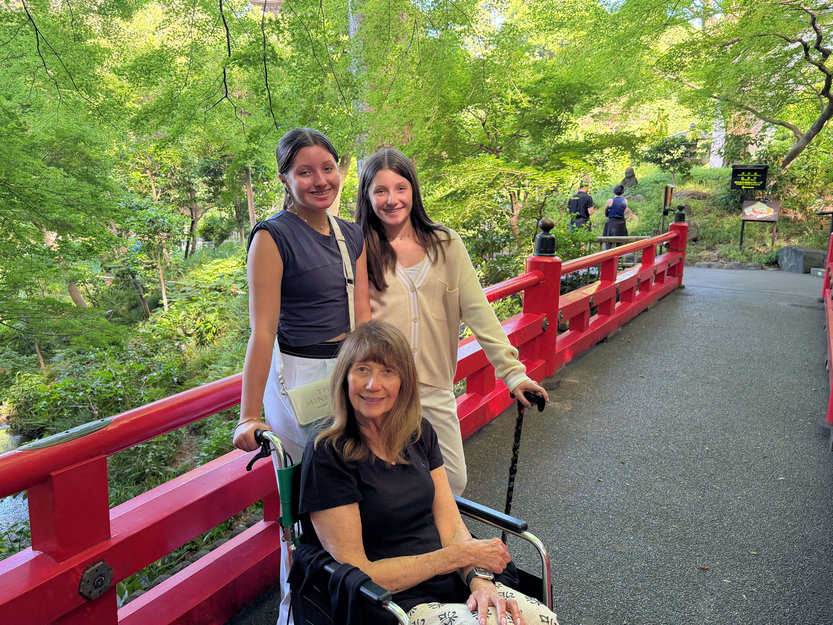
The gardens next to the Hotel Chinzanso in Tokyo are just magnificent! Marla, and I, with our granddaughters, explored the gardens every day during our stay in Tokyo. In 1878, Yamagata Aritomo came into possession of this area, built a large mansion with gardens and named it “Chinzanso.” Yamagata was a former Prime Minister of Japan and one of the key officials who established the Meiji Government. He was not only a politician, but also an art connoisseur who wrote poetry and was fond of gardens. Vast sections of the property including important buildings and gardens were incinerated by air raids in 1945 and had to be rebuilt. Chinzanso first opened as a hotel in in 1992. Prior to becoming a hotel, the historic 17-acre property operated primarily as a renowned public garden and reception center.

The gardens are just outside the door to our hotel.
We experienced one visual surprise after another.

Lots of large Koi in the Yusuichi Pond.

The Chinzanso Monument in 1897 recalls Aritomo’s discovery of the land and his deep fondness for it.

This three-story pagoda was built in the Muromachi period over 600 years ago in Hiroshima’s Chikurinji Temple. In 1925, the Chinzanso garden was passed from its original owner, Yamagata Aritomo, to Baron Heitara Fujita, who relocated the pagoda into the garden. There are only three ancient pagodas in Tokyo.

We walked up the hill to explore the area near the pagoda.

Sho Kanzeon Bosatu, the Goddess of Mercy, is enshrined in the pagoda.

A closer view of the Bodhisattva wood carving from the Edo period.

We entered a beautiful shrine down the hill from the pagoda.

Kate and Lauren are great explorers.

Lauren looks at traditional “omikuji” fortune papers tied to the shrine entrance.`

The shrine is dedicated to Inari Okami, the Shinto deity of rice, agriculture, and business prosperity.

The area around the Choshubaku Waterfall is very peaceful and serene.
You will love watching this video!

Stone diety statues of the Seven Gods of Good Fortune are scattered around the gardens. Visitors are encouraged to explore the pathways to find all seven statues, which tradition dictates brings good luck and immense riches.

This is Daikokuten, often called the God of wealth and fortune.

I’m exploring some of the stonepaths in the gardens.

Our hotel has a number of stand alone restaurants in the gardens. This is the Unakiku eel restaurant. Eating eel in Japan is a centuries-old culinary tradition. The most famous way to eat eel is kabayaki, a style where the meat is skewered, grilled over charcoal, and basted in a sweet, savory soy-based sauce


The Girls check out the entrance.

These are the stone statues of the Rakan. The rakan, the enlightened disciples of Buddha, have been the subject of devotion since the time of Edo, 1603–1867. They occupy such a special place in Japanese Zen Buddhism that they have become traditional figures of Japanese art.

This is a “Koshin” stone monument. Koshin is a religious sect of Chinese Taoist origin and was popular in Japan at the beginning of the Edo period. This monument was first erected in 1669 and it has remained at this location unchanged since then.

We are crossing the Benkei Bridge in the gardens.

Lauren takes a photo of a lovely hydrangea.

Kate takes Marla to look at the “Thirteen Tier Monument.” It was constructed in honor of the famous samurai and tea connoisseur, Oda Uraku, who lived in the Sengoku period, 1477 – 1573.

This is a section of the Japanese moss garden.

This area of the gardens with beautiful fencing enhances the tranquil setting.

We purchased tickets for the evening “Firefly” walk after our international buffet dinner.
If you look closely you can see little flashes of light from the fireflies in the river bed.

The gardens are unbelievably magical at night.


The Girls loved the last night in Tokyo. Next stop is Chiang Mai, Thailand.
Photos: Dick Gentry. Not to be used without permission.
About The Author

admin
Related Posts
A WONDERFUL TRIP TO VAIL WITH THE FAMILY
Marla and I were amazingly happy to have a family trip back to Vail, Colorado…
July 10, 2026
HONG KONG ENERGIZES THE SENSES LIKE VERY FEW CITIES IN THE WORLD. This was the last stop on our amazing travel adventure with our granddaughters.
The last leg of our granddaughters Japan, Southeast Asia, Singapore, and finally, Hong Kong tour…
July 10, 2026
Leave A Comment