EXPLORING THE FASCINATING EDFU TEMPLE, A GALABIYA PARTY, SAILING TO THE PHILAE TEMPLE, AND THE FAREWELL DINNER
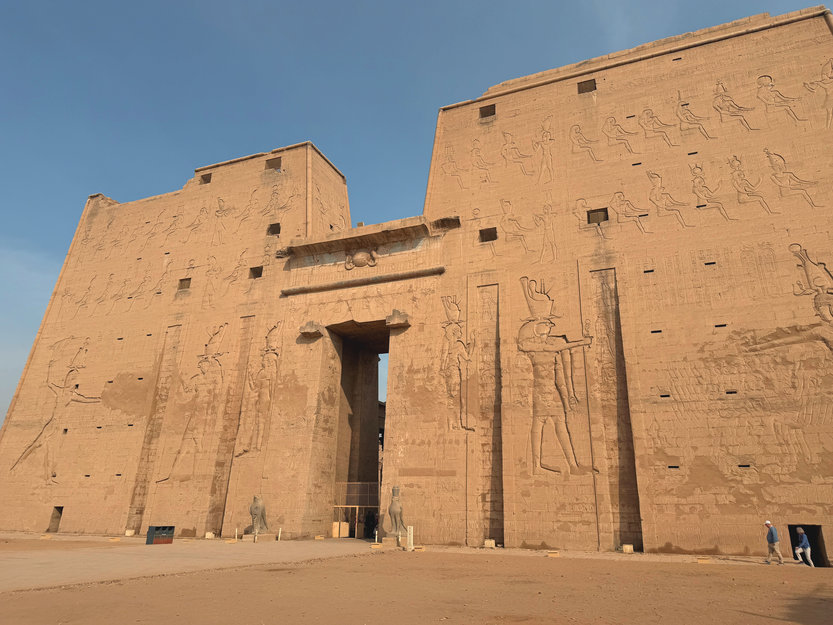
We visited the beautiful temple of Edfu, one of several temples built during the Ptolemaic Kingdom. The present temple began construction in 237 B.C.

The temple is remarkably well preserved. Over the centuries, the temple became buried to a depth of 39 feet beneath drifting desert sand and layers of river silt deposited by the Nile. Local inhabitants built homes directly over the former temple grounds. Only the upper reaches of the temple pylons were visible by 1798, when the temple was identified by a French expedition. In 1860 Auguste Mariette, a French Egyotologist, began the work of freeing Edfu temple from the sands.

The temple of Edfu is also known as the temple of Horus, the falcon god. (https://en.wikipedia.org/wiki/Horus.) The statue shown above is one of two large statues of Horus. Carved out of a single block of granite from Aswan, it stands before the entrance to the first “hypostyle hall” (a room with a roof supported by rows of columns). The doors of the hypostyle hall restrict access to the central portion of the temple. They were usually closed to the public except during some festivals.

Beautiful columns and walls are well preserved.

Our Egyptologist for the AHI tour, Rafaat Khatab, shared his knowledge of the heiroglyphs.

Massive columns inside the temple.

Tucked away at the very heart of the Temple of Edfu lies its most hallowed & sacred chamber, the “inner sanctuary”. Here, enshrined in reverence, once rested the sacred barque of Horus, the falcon-headed god of kingship and the sky. This ceremonial boat, carried aloft during great religious processions, was also accompanied by a permanent shrine that safeguarded the cult statue of the god, likely a splendid, gilded wooden effigy of Horus himself.

Marla and Dick exploring the temple.

A worker rests by ancient walls covered in detailed reliefs and hieroglyphs.

The walls at the Temple of Edfu were primarily defaced by early Christians during the late Roman period. They chiseled out the faces and eyes of gods and pharaohs to neutralize what they viewed as pagan demons. Sparrows find a safe spot to nest on the temple wall.

After a full day of touring we headed back to our ship.

Our ship had an armed guard with an automatic weapon. This was the only time I saw him as he was very discreet.

Traditional feluccas docked on the colorful banks of the Nile near Aswan, Egypt.

Our groups rides a felucca to the Philae Temple, located on Agilkia Island in Aswan.

Our head guide let a jewelry merchant on our boat who sold very well-priced necklaces and bracelets.

The Philae Temple complex, dedicated to the goddess Isis, is a stunning Greco-Roman site in Aswan, Egypt. It is famous for the famous “Osiris-Isis” myth. The story of Isis and Osiris is a central Egyptian myth of love, betrayal, and resurrection. Osiris, a wise king, was killed by his jealous brother Set, who cut his body into pieces. Isis searched for and resurrected him, allowing them to conceive their son, Horus, who later defeated Set to reclaim the throne. Originally on Philae Island, it was saved from flooding by a massive UNESCO-led project in the 1960s, which moved the entire temple complex to Agilkia Island.

Our group hears the story about the famous myth.


Coptic crosses were sometimes carved on Egyptian monuments to Christianize pagan spaces.


We saw a lot of very early graffiti carved on the walls.

Inside the temple of Philae.

It is hard to believe that this whole templex complex would have been 65 feet underwater if it hadn’t been moved from rising river caused by the new Aswan Dam.

Feluccas line up to pick up passengers from the island.

Tonight was very festive as we all dressed up in traditional Galbiyas.

The whole ship including the crew dressed up for the evening.

Marla descends the stairs the next evening for our farewell dinner.
Music and festivites.


The farewell dinner included a Dervish show and a belly dancer.
Photos: Dick Gentry. Not to be used without permission.
About The Author

admin
Related Posts
A WONDERFUL TRIP TO VAIL WITH THE FAMILY
Marla and I were amazingly happy to have a family trip back to Vail, Colorado…
April 24, 2026
A LOVE OF TREES
Kahlil Gibran once wrote,“Trees are poems that the earth writes upon the sky…
April 24, 2026
Leave A Comment